
Iran, nuclear hell

Today I am providing my English translation of an article by Margherita Furlan, originally in Italian and published on AntiMafiaDuemila.com on Tuesday 9th April 2026.
(All emphasis original, footnotes mine).
A map of the voices warning the world and the silence of those who should be listening
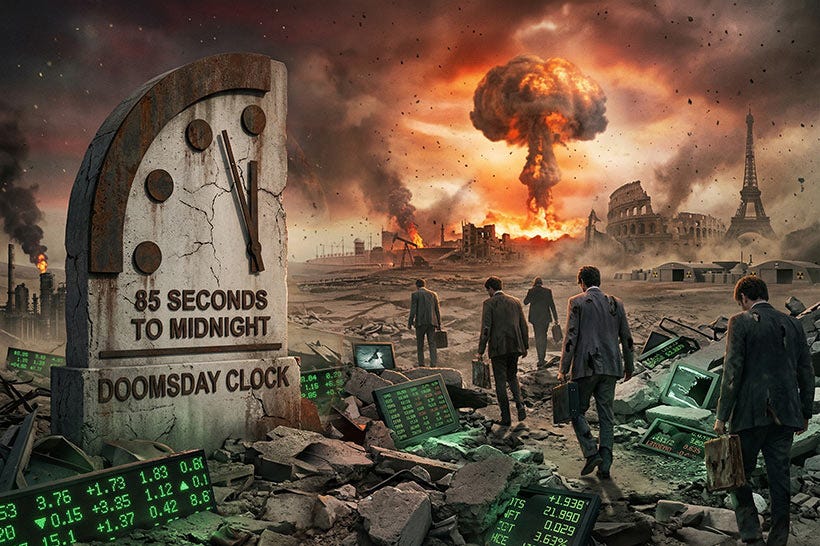
There comes a point in a journalist’s life when words are no longer enough. When professional jargon – the “it is feared”, the “sources report”, the “according to analysts” – becomes a cage that numbs the very thing it is meant to convey: the stark truth of what is happening. As I write, the planet is closer to nuclear catastrophe than it has been since the Cuban Missile Crisis of 1962. I am not the one saying this. It is the Doomsday Clock [link] of the Bulletin of the Atomic Scientists [link], standing at 85 seconds to midnight. It is stated by the nuclear emergency protocols that the World Health Organisation [WHO] is currently updating. It is stated by a United Nations diplomat who resigned to shout it to the world. But before delving into the array of voices speaking out, we must face the question that no major Western newspaper dares to ask clearly: who wanted this war, and why?
The US-Israel war against Iran began on 28th February 2026, exactly four weeks after the publication, on 30th January, of 3 million pages of the Epstein files by the US Department of Justice. Those documents shook Anglo-Saxon power: the arrest of former Prince Andrew and former British Ambassador Peter Mandelson, the hearing of Commerce Secretary Howard Lutnick, the scrutiny of Epstein’s deep ties to the Israeli services. Then, on 28th February, the world moved on to other matters. As Republican Thomas Massie observed, the war “will not make the Epstein files disappear”. But it has overshadowed them. And this timing is not the only coincidence.
An investigation by Byline Times documented what we might call the structural conflict of interest within the Epstein coalition: the three most senior figures at Palantir Technologies, the artificial intelligence firm at the heart of the surveillance apparatus that provided the intelligence to justify US-Israeli strikes on Iran, had each publicly advocated for precisely the military confrontation that ensued.
Peter Thiel, co-founder of Palantir and PayPal, appears in the Epstein files with correspondence dating from 2014 to 2019. A former Israeli prime minister, Ehud Barak, described Thiel and Epstein as “owners” of a venture capital fund. Thiel has publicly argued that any nuclear acquisition by an adversary has historically led to regional war, framing an Iranian nuclear weapon as a “catastrophe” requiring pre-emptive action. Palantir signed a strategic partnership with the Israeli Ministry of Defence in January 2024.
Alex Karp, CEO of Palantir, has long stated that a confrontation with Iran is “inevitable” and that war would demonstrate the value of the company’s autonomous weapons system. Joe Lonsdale, another co-founder, said he hoped to “invest in Iran” following a regime change. The war has gone well, for now, for Palantir’s shareholders: the share price rose by 7% in the first week of the conflict.
Joining this network are Larry Fink (BlackRock), who visited Italy in 2025 to meet with the country’s highest-ranking officials, and Elon Musk (Starlink, SpaceX, X/Twitter), whose name also appears in the Epstein files released by the House Oversight Committee. The Starlink network provides communications infrastructure in conflict zones; BlackRock manages trillions of dollars in assets that benefit from geopolitical volatility; Palantir provides the surveillance that guides the bombings.
War is the product. Chaos is the raw material. And the person behind it has a first name, a surname, and documented links to a sexual blackmail and intelligence operation that the US courts are still trying to unravel.
Whilst the Director of National Intelligence, Tulsi Gabbard, confirmed to Congress that the consensus of the US intelligence community is that Iran has not been pursuing a nuclear weapon since 2003, the Trump administration has rejected that assessment. The intelligence used to justify the war was provided by Israel. And processed by Palantir. This is the context. This is the machine. Now let us look at who, within the international system, is trying to stop it — or at least to shout that the machine is hurtling towards the precipice.
The United Nations: the alarm from the Glass Palace
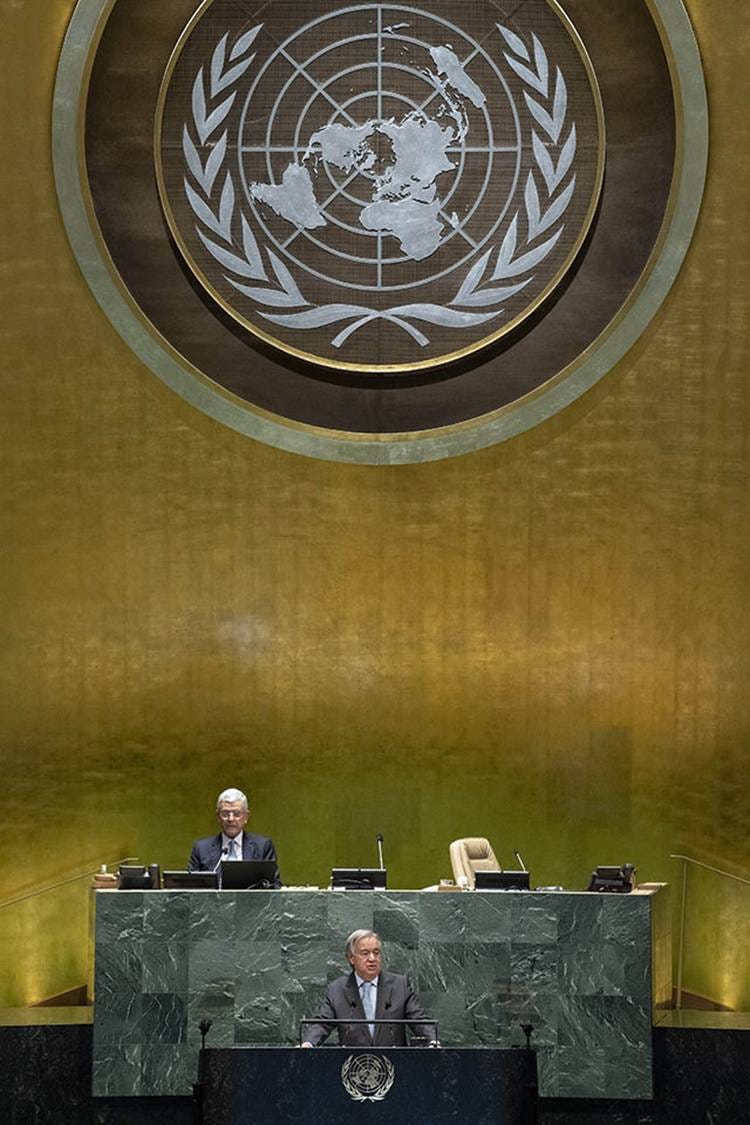
António Guterres, 77, a Portuguese national and former UN High Commissioner for Refugees (2005–2015), has been UN Secretary-General since 2017. On 28th February 2026, a few hours after the bombing began, he issued a public statement on X and subsequently addressed the Security Council, which had been convened for an emergency session at the request of China and Russia. “I condemn the military escalation in the Middle East. The use of force by the United States and Israel against Iran, and Iran’s subsequent retaliation in the region, undermine international peace and security. […] Military action carries the risk of triggering a chain of events that no one can control in the world’s most volatile region” – António Guterres, 28th February 2026.
Guterres emphasised that the joint operation took place during indirect US-Iran negotiations mediated by Oman and described the military decision as a way of “wasting a diplomatic opportunity”. He then called for an immediate cessation of hostilities and a return to the negotiating table, “in particular regarding the future of Iran’s nuclear programme”.
Volker Türk, an Austrian lawyer who has served as High Commissioner since 2022, spoke on 20th March 2026, three weeks after the war began. “The human cost of this reckless war is alarming. Hostilities are being waged with no regard for the immediate and long-term consequences for civilians across the entire region. […] Attacks on energy infrastructure, including South Pars in Iran and Ras Laffan in Qatar, will only exacerbate the suffering” – Volker Türk, 20th March 2026. Türk reported that Israeli and American forces had struck residential complexes, medical facilities, schools, shops, courts, UNESCO1 World Heritage sites and energy installations. According to the Iranian Red Crescent, 67,414 civilian sites have been hit, including 498 schools and 236 healthcare facilities.
Rafael Mariano Grossi, an Argentine diplomat, has led the International Atomic Energy Agency [IAEA] since 2019. He is the world’s most authoritative technical voice on nuclear matters. On 2nd March, during a briefing to the Board of Governors in Vienna, he activated the Incident and Emergency Centre in continuous operational mode. “The situation today is very worrying. A radiological release with serious consequences cannot be ruled out if the conflict escalates or if critical infrastructure is damaged. […] The lasting solution lies on the diplomatic table. Diplomacy is difficult, but it is never impossible. Nuclear diplomacy is even more difficult, but it is never impossible” – Rafael Grossi, 2nd March 2026.
Grossi revealed that the IAEA cannot provide information on the location, composition or size of Iran’s enriched uranium stockpiles, as inspectors have had no access since June 2025. More than 400 kg of 60% enriched uranium, sufficient for approximately 9–10 nuclear weapons, is in an unknown location. Following the bombing of the Natanz facility on 21st March, the IAEA called for military restraint “to avoid any risk of a nuclear accident”.
Hanan Balkhy, a Saudi doctor and infectious disease specialist, is the World Health Organisation’s Regional Director for the Eastern Mediterranean. Her interview with Politico in March 2026 revealed that the WHO is updating its protocols for a full-scale nuclear scenario. “The worst-case scenario is a nuclear accident, and that is what concerns us most. Staff are prepared for a nuclear accident in the broadest sense, including an attack on a nuclear facility or the use of a weapon” - Hanan Balkhy, WHO. The WHO has detailed the potential health risks: acute lung and skin injuries, increased long-term cancer rates, and psychological effects. It cited the precedents of Chernobyl, Hiroshima and Nagasaki. The organisation is conducting additional training for staff and developing updated recommendations on public health response to radiological emergencies.
Mohamad Safa, the Lebanese chief representative of the Patriotic Vision organisation to the United Nations, is the most striking case: on 30th March 2026, he publicly resigned, stating that he had given up his diplomatic career to “leak information” about the nuclear risk. “The United Nations is preparing for the possible use of a nuclear weapon against Iran. I have given up my diplomatic career to reveal this information, because I do not want to be part of this crime against humanity, in an attempt to prevent a nuclear winter”. – Mohamad Safa, 30th March 2026.
Safa accompanied the statement with a photograph of Tehran, pointing out that it is a city of nearly ten million inhabitants – families, children, pets, workers with dreams – not a depopulated desert. He urged the world’s population to take to the streets and “protest for our humanity and our future. Only the people can stop this. History will remember us”. [link]
The Independent Experts of the Human Rights Council
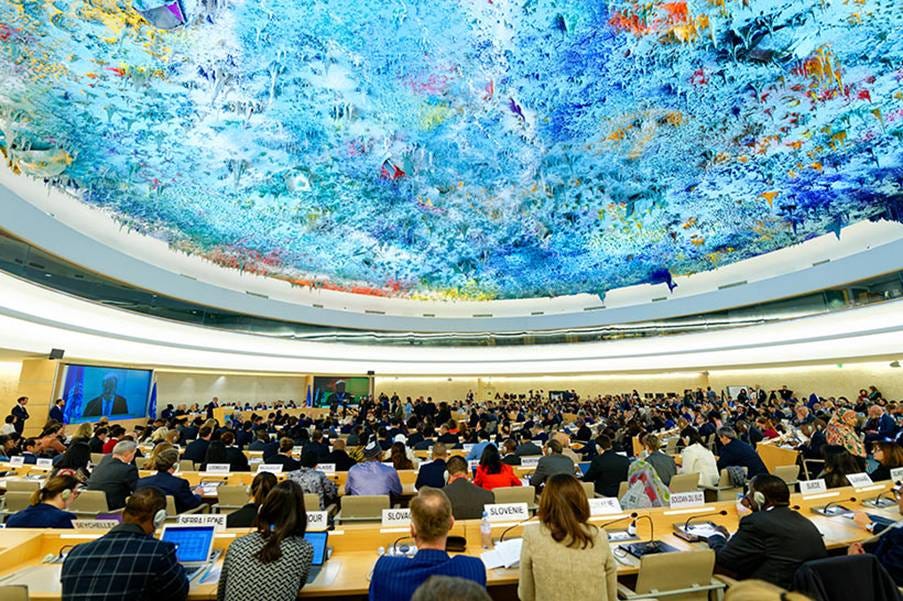
The UN system has “Special Procedures”, independent experts appointed by the Human Rights Council. They issued three joint statements between 4th and 12th March 2026.
4th March – First statement (30 signatory experts). Coordinated by the Special Rapporteur on Iran, Mai Sato, the Special Rapporteur on the right to education, Farida Shaheed, and the Special Rapporteur on extrajudicial executions, Morris Tidball-Binz. “These attacks do not target military abstractions – they target people. Civilians are paying the price of this war with their lives, their safety, their environment and their health. Illegal military intervention is not the solution to the nuclear issue, to alleged terrorism, nor to the human rights situation in Iran” – Joint statement, OHCHR2, 4 March 2026.
12th March – Second statement. The conflict “risks engulfing the entire region in catastrophic armed violence” and “setting a further precedent of total impunity for some of the world’s most powerful military forces.” It explicitly condemns the US demand for “unconditional surrender” and Trump’s statements about wanting to “choose Iran’s future leadership”.
The Independent Fact-Finding Mission on Iran (established in 2022, mandate extended in January 2026) added: “The rules of international law must apply to everyone consistently; they cannot vary depending on the State acting.”
Ted Chaiban, Deputy Executive Director of UNICEF3, stated that the recent escalation has killed or injured “the equivalent of a classroom full of children every day” in Lebanon alone. The attack on the Shajareh Tayyebeh girls’ primary school in Minab, in Hormozgan province [see here], on the first day of the war [covered here], killed at least 165 schoolgirls aged between 7 and 12.
The World Food Programme (WFP) has warned that 45 million people could face extreme levels of hunger if the war continues and fuel prices keep rising. The closure of the Strait of Hormuz has triggered what has been described as the biggest disruption to energy supplies since the 1973 crisis.
Think tanks: the strategic analysis of the apocalypse
Bulletin of the Atomic Scientists — 85 seconds to midnight.
Founded in 1945 by scientists from the Manhattan Project, including Albert Einstein and J. Robert Oppenheimer, the Bulletin of the Atomic Scientists is the global benchmark for assessing nuclear risk. In January 2026, its Doomsday Clock was set to 85 seconds to midnight: the closest humanity has ever been to catastrophe in the clock’s history. Midnight represents the nuclear annihilation of humanity.
Joe Cirincione, former president of the Ploughshares Fund and America’s leading expert on arms control, wrote on 28th February: “Trump has just started a dangerous and pointless war against Iran”. His analysis warns that, with the stated aim of regime change, for Iranian leaders this is an existential war in which “nothing is off the table”, including the rush to process stocks of 60% enriched uranium into a working nuclear device.
On 2nd March, the Bulletin organised a panel moderated by Alexandra Bell (former Senior Advisor at the US State Department) featuring Kelsey Davenport (Arms Control Association) and Jeffrey Lewis (Middlebury Institute). The panel described Operation “Epic Fury” as an escalation leading the world to a “dangerous crossroads”.
The Nuclear Notebook 2026 revealed that the US nuclear strategic plan (OPLAN 8010-12) includes Iran as one of four designated adversaries and that, under Trump, military options for Iran include a “renewed emphasis on nuclear weapons”.
Chatham House – The chain reaction of proliferation. Chatham House (Royal Institute of International Affairs), founded in London in 1920, published an analysis by its International Security Programme on 30th March [2026] entitled: “War in Iran risks triggering a new wave of nuclear proliferation”. Three key points: Iran was attacked twice whilst negotiations were ongoing (June 2025 and February 2026), sending the message that “dialogue does not protect”. The new Supreme Leader, Mojtaba Khamenei, is reported to be more hardliner than his father, who had issued a fatwa against nuclear weapons. Saudi Arabia could follow suit: Mohammed bin Salman has already warned that the Kingdom will seek the bomb if Iran obtains it.
SIPRI, ICAN, Arms Control Association. SIPRI (the Stockholm International Peace Research Institute, founded in 1966) has warned that a nuclear conflict is imminent if the escalation is not halted, confirming that arms control mechanisms are “more fragile than ever.” SIPRI estimates Israel’s arsenal at around 80 warheads.
ICAN (International Campaign to Abolish Nuclear Weapons, 2017 Nobel Peace Prize laureate) has condemned the attacks on Natanz through its Executive Director Melissa Parke (a former Australian MP and UN official): “Striking nuclear facilities is explicitly prohibited under international law and risks causing radioactive contamination”. Alicia Sanders-Zakre, ICAN’s policy director, added: “As long as a country possesses a nuclear arsenal, there is a risk that it will be used intentionally or accidentally”.
Daryl G. Kimball, executive director of the Arms Control Association (founded in 1971, Washington), warned: “History shows that nuclear threats against non-nuclear States are not effective in compelling their behaviour. Trump and Netanyahu have operated outside the bounds of domestic law and international law, and each has exclusive, virtually unchecked authority to order the use of nuclear weapons” – Daryl G. Kimball
Defense Priorities, FPRI, ACLED. Jennifer Kavanagh, director of military analysis at Defense Priorities (Washington), told Time Magazine: “A nuclear bomb could be the quickest way to restore deterrence for a regime that is more radical and has been attacked twice during negotiations”.
On 28th February, the FPRI (Foreign Policy Research Institute, Philadelphia) published a joint analysis featuring contributions from Aaron Stein (President), Afshon Ostovar (Naval Postgraduate School) and Emily Holland (Director for Eurasia). ACLED [Armed Conflict Location & Event Data] has launched an Iran Crisis Hub featuring daily data, recording hundreds of attacks in at least 26 of Iran’s 31 provinces.
Academic voices
John Joseph Mearsheimer, 78, R. Wendell Harrison Distinguished Service Professor of Political Science at the University of Chicago and author of The Tragedy of Great Power Politics and The Israel Lobby and US Foreign Policy (with Stephen Walt), is one of the world’s most influential academic voices on American foreign policy. “The Trump administration was dragged into this war by Israel and its huge and powerful lobby in the United States. Both Secretary of State Marco Rubio and Speaker of the House Mike Johnson have admitted this. […] We are sending a message: we are a bunch of fools. We have started a war. We cannot win it” - John Mearsheimer, March 2026. On the nuclear risk, Mearsheimer warned that Saudi Arabia might pursue nuclear weapons, recalling Riyadh’s role in funding Pakistan’s nuclear programme. In an interview with Middle East Eye, he stated: “If the Israelis lose in Iran…”, implying that a nuclear escalation could be a real outcome.
Ramesh Thakur, professor emeritus and director of the Centre for Nuclear Non-Proliferation and Disarmament at the Crawford School of the Australian National University, and former UN negotiator with Iran: “For Iran, nuclear weapons are now the only thing that will guarantee the regime’s survival. So why shouldn’t they acquire them?” – Ramesh Thakur.
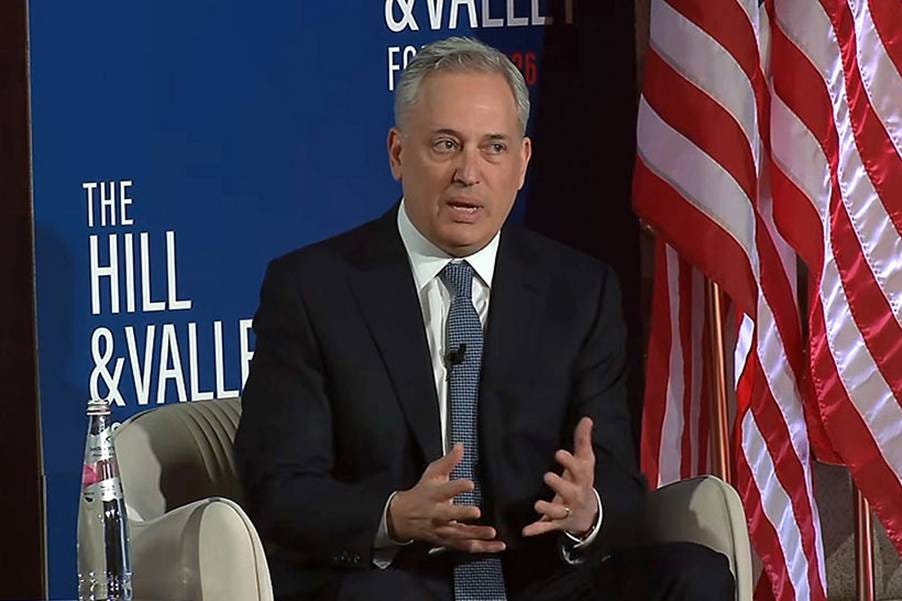
David Sacks, the White House’s “kingpin” on AI [Artificial Intelligence] and crypto, has publicly stated that Israel might consider using nuclear weapons against Iran: this is the first time a senior US official has openly acknowledged Israel’s nuclear arsenal in this context. He also suggested that the US should “declare victory and withdraw.” Trump replied: “Israel would never do that.”
International magazines
The nuclear threat has taken centre stage in the coverage of major publications: Bulletin of the Atomic Scientists (daily coverage, Nuclear Notebook 2026); Time (report on post-war proliferation, 27th March [2026]); Bloomberg/Boston Globe (“War with Iran May Be Ushering in New Nuclear Age”, 29th March [2026]); TRT World (“Nuclear Brink”, 29th March [2026]); Politico (investigation into WHO nuclear preparations); Middle East Eye (interview with Mearsheimer); Byline Times (investigation into Palantir); House of Commons Library (updated briefing).
The great silence: the absence of debate in Europe and Italy
And now we must talk about what is not there. Whilst the UN Secretary-General condemns, whilst the WHO prepares protocols for a nuclear incident, whilst a diplomat resigns to sound the alarm, whilst Chatham House and the Bulletin of the Atomic Scientists publish daily analyses on the very real possibility of a nuclear detonation in the Middle East, Europe remains silent. And Italy, in its silence, is perhaps the most culpable.
It is not entirely silent, let that be clear. It is silent where it matters. [Italian Prime Minister Giorgia] Meloni stated in the [Italian] Senate on 11th March that the US-Israeli intervention took place “outside the framework of international law” and that Italy “is not participating and does not intend to participate”. Defence Minister [Guido] Crosetto admitted in Parliament that the Israeli attack took place “outside the rules of international law”.
But where is the debate? Where is the analysis? Where is the critical conscience?
56% of Italians oppose the US-Israeli military intervention, according to a YouTrend poll for SkyTG24. 48% call for neutrality and mediation. Yet the parliamentary debate has been reduced to a bureaucratic management of the crisis: how many ships to send to the Gulf, how to protect the 58,000 Italians stranded in the Middle East, whether to authorise the use of NATO bases. No parliamentary session dedicated to the nuclear risk. No hearing of non-proliferation experts. No commission of inquiry into the intelligence chain that led to this war.
The Five Star Movement has sought clarification on the use of the Sigonella base and the MUOS4 station in Niscemi, which have already been involved in operations against Iran. But the fundamental question – whether Italy is providing logistical infrastructure for an operation that risks triggering the first nuclear detonation since 1945 – has never been posed with such clarity in Parliament.
The European right is torn. As Euronews has reported, the sovereigntist parties, from Fidesz to the Lega, from AfD5 to Rassemblement National, are unable to reconcile their support for Trump with their voters’ fears over energy prices, migration waves and instability. [Matteo] Salvini6, who has repeatedly called for Trump to be awarded the Nobel Peace Prize, remains silent. The Lega “prefers the diplomatic route” but dares not criticise Washington. German President Frank-Walter Steinmeier has described the military campaign as a “politically disastrous mistake” and a “violation of international law”, but Germany is debating whether to develop its own nuclear deterrent.
And what of culture? Italian newspapers cover the daily news of the conflict, but no major publication has published an investigation comparable to those by the Bulletin, Chatham House, Time or the Byline Times. No talk show has invited an expert on nuclear non-proliferation to explain to Italians what the bombing of Natanz or the Iranian attack on Dimona actually means. No literary festival, no academic conference, no gathering of intellectuals has asked the fundamental question: are we on the brink of a third world war, and who is deciding it for us?
Italy hosts more than 120 US military bases across the country (a further 20 are secret), Italy holds (according to estimates) between 20 and 50 B61 nuclear bombs at the Aviano and Ghedi bases, is a member of NATO’s nuclear sharing arrangement, has more than a thousand UNIFIL7 soldiers in Lebanon, under Israeli bombardment, and has 58,000 citizens stranded in the Middle East. And it does not discuss the nuclear risk.
There is something deeply wrong with a country that finds itself at the geographical and strategic centre of a crisis that could lead to the first atomic detonation in 81 years, yet says nothing about it.
This article shouldn’t exist. It shouldn’t be necessary to list, one by one, the names of the people and institutions who are warning the world that we are on the brink of a nuclear abyss. An article shouldn’t be needed to prove that the risk is real, because it should be obvious. And yet here we are. Because the UN Secretary-General issues a warning and is ignored. Because the Director General of the IAEA warns that a radioactive release is possible and no European news programme opens with that story. Because the WHO is preparing protocols for a nuclear accident and the public is not being informed. Because a diplomat sacrifices his career to warn the world and his voice is lost in the noise.
Here we are because a coalition of financial, technological and intelligence interests, linked by documented threads to a sexual blackmail operation that the courts are still unravelling, has produced a war that no American ally asked for, that the American intelligence community did not justify, that negotiations were on the verge of rendering unnecessary. Here we are because four hundred kilograms of 60% enriched uranium have vanished. Because the Natanz facility was bombed. Because Dimona was struck. Because the US strategic nuclear plan includes Iran as a designated target, and the President who controls that plan has the exclusive and unchecked power to press the button. I have written a book on the multipolar transition. I have analysed de-dollarisation, the BRICS, energy corridors, the encroachment of global financial capital on sovereignty, and the risks faced by the so-called Global South. But nothing prepared me for writing an article in which I must document, with sources, that the risk of a nuclear war is not an academic hypothesis but a real possibility for which international institutions are already preparing to manage the consequences. The Doomsday Clock stands at 85 seconds to midnight. The WHO is updating protocols for a radiological emergency. A UN diplomat has resigned to warn that the United Nations is preparing for the unthinkable. Chatham House warns of a wave of nuclear proliferation. SIPRI says that arms control mechanisms are more fragile than ever. Trump and Netanyahu each have virtually unchecked authority to order the use of nuclear weapons. And Europe is debating customs tariffs. There are 165 little girls buried in Minab who will never discuss anything again. There are ten million people in Tehran who wake up every morning under bombardment without knowing whether their city will still exist the next day. There are forty-five million human beings facing starvation because the Strait of Hormuz is closed. There are Italian soldiers in Lebanon under bombardment. There are American nuclear bombs in Friuli-Venezia Giulia. And we, in Italy, in Europe, at the heart of this storm that we did not ask for and that we cannot stop on our own, do not speak of it.
(Published on 2nd April 2026)
War is the product. Chaos is the raw material. And silence is complicity.
Copyrighted images have been used for non-commercial purposes and fall within the scope of fair use.
United Nations Educational, Scientific and Cultural Organization
Office of the United Nations High Commissioner for Human Rights
United Nations International Children's Emergency Fund
Mobile User Objective System - a US Space Force narrowband military communications satellite system that supports a worldwide, multi-service population of users in the ultra high frequency band. The system provides increased communications capabilities to newer, smaller terminals while still supporting interoperability with legacy terminals - Wikipedia
Alternative für Deutschland (German for Alternative for Germany)
Italian politician serving as Deputy Prime Minister of Italy and Minister of Infrastructure and Transport since 2022. He has been Federal Secretary of Italy's Lega party since December 2013 - Wikipedia
United Nations Interim Force in Lebanon
Thanks for this important article translated from Italian, Ismaele.
Truly, the point we're at is a kind of collective insanity, and we have to get to a place of peace, sensibility and and fairness.
This paragraph jumped out at me:
"David Sacks, the White House’s “kingpin” on AI [Artificial Intelligence] and crypto, has publicly stated that Israel might consider using nuclear weapons against Iran: this is the first time a senior US official has openly acknowledged Israel’s nuclear arsenal in this context. He also suggested that the US should “declare victory and withdraw.” Trump replied: “Israel would never do that.”"
So much is revealed. The USA and Israel have to be reigned in.
Painting a dire scenario feeds the frenzy it claims to warn against. Preparation is needed. Panic is not. The root cause of this madness remains unaddressed — because those with leverage are playing global chess, not looking for checkmate. A nuclear strike won't just end a war. It will open a door for worse.