

Today I am providing my English translation of an article by Nicola Bielli, originally in Italian and published on ComeDonChisciotte.org on Friday 26th June 2026.
(All emphasis and footnotes mine).
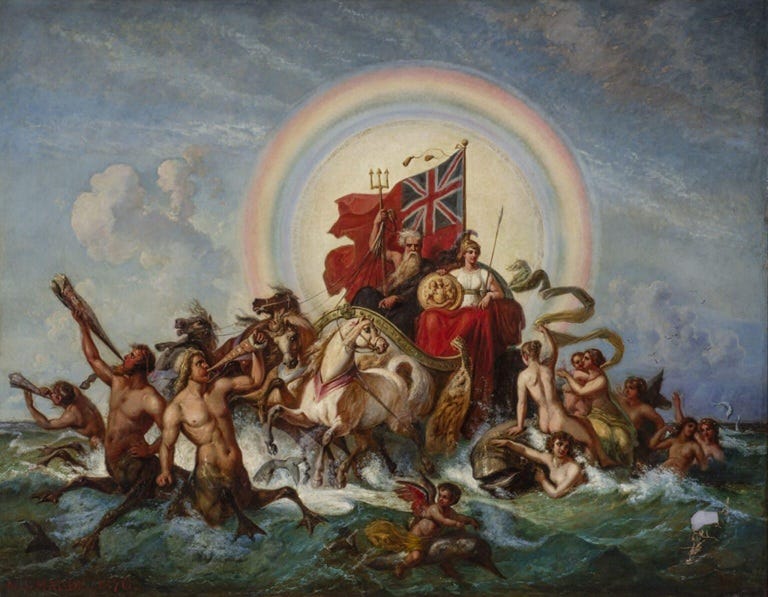
While Europe witnesses yet another escalation in the standoff between NATO and Russia, one question continues to remain on the fringes of public debate: why does the United Kingdom often appear more determined than other European countries to adopt an increasingly hardline stance towards Moscow?
The official explanations are well known: the defence of Ukraine, the protection of international law, European security, and the containment of the Kremlin’s geopolitical ambitions. These are certainly relevant arguments, but they may not tell the whole story.
To understand the deep-rooted causes of the British stance, we may need to look elsewhere – not to Westminster, but to the financial heart of London. Not at the daily news reports on the war in Ukraine, but at the power structures that have run through British history for centuries.
It is here that the analysis by economist Richard Murphy offers an unusual and provocative perspective.
According to Murphy, one of the best-known scholars of tax dynamics and offshore havens, the City of London is not simply a financial district. It is a power structure with exceptional characteristics within the British State.
The City of London Corporation, which governs the historic Square Mile, is in fact an anomaly almost unique in the Western world. Companies can vote in its elections. It has its own institutions, its own police force and privileged access to the decision-making centres of British power. Formally, it is a local authority. In substance, Murphy argues, it represents the political centre of a global financial network.
This is not merely a medieval relic that has survived by inertia. According to this interpretation, the Corporation continues to fulfil a specific function: to defend the interests of financial capital against any form of democratic control that might restrict its freedom of movement.
It is a radical thesis. But it is precisely by starting from this thesis that it becomes possible to view some of the major contemporary geopolitical dynamics in a different light.
Over the last forty years, the United Kingdom has undergone a profound economic transformation. The country that had spearheaded the Industrial Revolution has gradually reduced the importance of manufacturing. Entire industrial districts have fallen into crisis. Mines, steelworks and shipyards have given way to an economy increasingly dominated by finance, services and the international management of capital.
The City has become the beating heart of this new model.
London no longer exports primarily industrial goods. It exports financial services, insurance, legal consultancy, investment instruments and global brokerage.
In other words, the prosperity of a significant part of the British establishment now depends on the survival of an international order founded on the free movement of capital and the centrality of Western economic institutions.
It is at this point that the economic discourse inevitably turns into a geopolitical one.
[This is] because every economic system develops its own worldview and its own conception of security.
Historically, British power has been the power of the sea. The British Empire built its greatness by controlling trade routes, maritime traffic, insurance and international finance. It did not dominate through territorial continuity but through networks.
For centuries, Russia has represented its opposite.
An immense continental power, founded on control of land, natural resources and strategic depth. A geopolitical civilisation built around the land, not the sea.
European history has, to a large extent, been the history of this confrontation.
From the Great Game in Central Asia to the Crimean War, from the Tsarist era to the Cold War, London has consistently viewed Russia as its principal continental rival.
The end of the Soviet Union seemed to close that chapter, but today, however, the conflict has returned.
And perhaps this is not merely a coincidence.
In Murphy’s interpretation, the City represents the modern evolution of Britain’s traditional maritime power. No longer a thalassocracy based on military fleets and colonies, but a financial thalassocracy based on capital flows, global markets and the offshore network linking London to the former structures of the empire.
From this perspective, Russia does not appear merely as a geopolitical adversary; it represents something deeper: the persistence of an alternative logic to that of financial globalisation. A logic based on State sovereignty, control of strategic resources and the possibility of escaping, at least in part, the influence of the major Western financial centres.
This raises an inevitable question.
If the City’s centrality depends on the existence of a particular world order, what happens when that order enters a crisis?
The rise of China, the strengthening of the BRICS, the search for payment systems alternative to the [US] Dollar and the emergence of new Eurasian alliances are gradually eroding the balance of power that has characterised the post-1991 world.
For Western financial elites, this is a potentially epoch-making transformation, and it is within this context that some observers interpret the growing British activism in the Ukrainian crisis.
London has often been at the forefront of military support for Kiev. It has backed increasingly severe sanctions against Moscow. It has encouraged a particularly assertive strategic posture in the Baltic, the North Sea and the areas of contact between NATO and Russia.
According to Murphy’s critical interpretation, these choices cannot be understood solely through the lens of military security.
They also reflect the need to defend an economic and financial system that perceives any reduction in its global centrality as a threat.
Of course, this interpretation remains a matter of debate. There is no evidence to suggest that the City directly orchestrates British strategic decisions. Nor would it be correct to reduce the UK’s entire foreign policy to the interests of the financial sector, but it would be equally naïve to ignore the influence that economic structures exert on States’ geopolitical choices.
The real issue, then, concerns the future of Europe.
If the confrontation with Russia continues to intensify, the continent risks finding itself once again trapped in the logic of opposing blocs. A logic that the history of the twentieth century has already shown to be capable of transforming economic and strategic rivalries into devastating conflicts.
It is precisely here that Murphy’s argument takes on a disturbing dimension.
When a power structure perceives the possibility of losing its dominant position, the temptation to respond through escalation can become very strong. Not necessarily by deliberate choice, but as a consequence of a systemic logic that equates its own survival with that of the existing order.
The final question therefore remains open.
Is the growing tension between the West and Russia really just a battle for European security? Or are we also witnessing the reaction of a global financial system that sees its hegemony under threat?
In the heart of London, within that square mile that continues to exert a disproportionate influence on world affairs, lies perhaps part of the answer.
The City of London is not merely a financial centre. It is the heart of a specific political, economic and social model, which we might define as transnational oligarchic financialism. According to Murphy, the problem is not finance per se, but the fact that finance has become the organising principle of society as a whole. In this model, power derives not primarily from the vote, from labour or from industrial production, but from the mobility of capital. Those who control financial capital wield greater leverage than democratically elected governments. The consequence is a profound transformation of democracy. Formally, democratic institutions continue to exist: people vote, parliaments are elected, and governments are formed. However, Murphy argues, the scope of what decisions are actually possible is restricted by the need not to disrupt the financial markets. Governments may change, but only within limits defined by the reaction of investors, banks, funds and the City.
This gives rise to a sort of conditional democracy. Elections determine who governs, but do not fully determine what can be done. Popular sovereignty is subordinated to market confidence.
From this perspective, the tax system takes on a central role. Murphy interprets the British offshore network not as a deviation from capitalism, but as one of its fundamental instruments. Tax havens linked to the United Kingdom – from the Cayman Islands to the British Virgin Islands, via Jersey and Guernsey – allow large fortunes to evade taxation, regulation and, above all, democratic control.
From this emerges a second element of the model: the separation of wealth from social responsibility.
In the tradition of the European welfare state, those who benefit most from the economy contribute most to the financing of the community. In the model criticised by Murphy, however, capital gains the ability to evade this pact. Economic elites become increasingly less dependent on the national territory, while ordinary citizens remain tied to the State, public services and ordinary taxation.
This creates a form of implicit dual citizenship: on the one hand, ordinary citizens, subject to laws, taxes and public decisions; and on the other, mobile capital, which can move wherever it wishes, choosing the most convenient jurisdiction and constantly threatening to flee.
According to Murphy, this results in a form of permanent blackmail. Any attempt to increase taxation on large fortunes, strengthen workers’ rights or expand public spending is immediately met with the objection that “capital will leave”.
The result is a progressively weakened State.
Here, the third pillar of the model emerges: the supremacy of rent over production.
Murphy argues that the central role of the City has driven the UK to gradually abandon manufacturing and productive investment. Instead of creating new wealth through industry, research and innovation, the economy is geared towards the management of financial assets, property speculation and the appreciation of existing wealth. Within this framework, the home ceases to be a social good and becomes an investment.
Cities cease to be places to live and become property portfolios. Companies are valued more for their share price than for what they produce. Capital seeks immediate financial returns rather than long-term productive development. The resulting society is characterised by growing inequalities. A minority linked to global financial circuits accumulates ever-increasing wealth, while wages, public services and local investment stagnate. In sociological terms, Murphy describes a society divided between:
a small global financial elite;
a professional class working in the service of finance;
a majority of workers and citizens who suffer the consequences of decisions taken elsewhere.
This also gives rise to a crisis of democratic legitimacy. If citizens perceive that any government must, in any case, obey the same financial interests, mistrust in institutions and politics grows. For Murphy, in fact, contemporary populism stems not only from cultural or identity-based factors but also from the perception that there are two sets of rules: one for the population and one for global capital.
In the background, one can glimpse an almost neo-imperial conception of British power. Murphy suggests that the formal end of the Empire did not eliminate the structures of domination built up during the colonial era. These have reportedly transformed into a global financial network centred on the City, capable of exerting influence without direct territorial control.
The gunboat empire has reportedly been replaced by the empire of financial flows.
Ultimately, a very specific model of society emerges: not a social democracy based on labour, nor a nation-State that regulates the economy, nor even productive, industry-oriented capitalism; but a system in which global financial capital occupies the apex of the hierarchy, the State assumes the role of guarantor of its freedom of movement, and democracy is progressively adapted to the needs of finance. For Murphy, therefore, the City is not merely a geographical location in central London. It is the institutional expression of a political order in which the freedom of capital is regarded as more important than democratic sovereignty, social equality and productive development. This is why he speaks not of a mere reform, but of a genuine constitutional transformation of the relationship between finance, the State and democracy.
Will Britain, and with it old Europe, be sacrificed by these elites simply to avoid coming to terms with the “Telluro-Eurasian” shift in history?
SOURCES
Richard Murphy, The Joy of Tax (2015) and articles on the role of the City of London Corporation and British tax havens.
Susan Strange, Casino Capitalism (1986) e Mad Money (1998).
Halford J. Mackinder, Democratic Ideals and Reality (1919).

I agree with Murphy. It makes totally sense if we look at the last 150-200 years, with people like Cecile Rhodes, the Rothschild family, the British royals, but also to the wealthy Americans with British roots. The oligarchs also need different physical locations to move their assets around.
Alex Krainer often mentions the City.
Yes it is a condition many of us in this country (UK) are well aware of even though it can't always be put into words . What a pity the article didn't venture into the what the consequences of the defeat of this financial hierarchy may be . But perhaps that is for another time , or even if that reality comes about as it well may .