

Today I am providing my English translation of an article by Marilina Veca, originally in Italian and published on ComeDonChisciotte.org on Thursday 30th July 2026.
(Italics original, bold emphasis and footnotes mine).
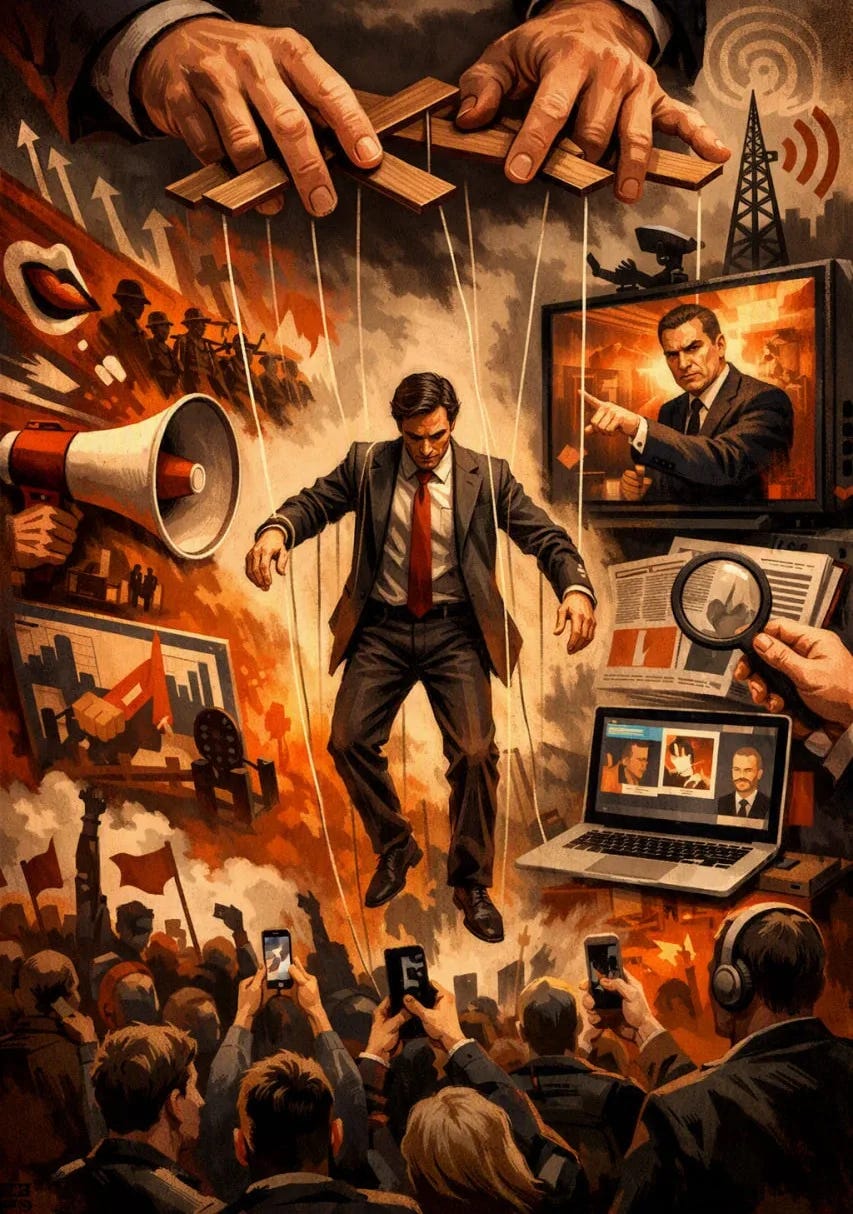
Nowadays, wars are not declared; they simply happen. Nowadays, wars do not begin or end: they peter out and drag on in oblivion and perpetual conflict. Wars fought with weapons are prepared through wars of words. Propaganda, media bombardment, hidden and overt messages, the fabrication of false evidence, a complete reversal of objective reality, false witnesses, famous pundits and professional do-gooders: everything serves to make the real war, the one fought with weapons, acceptable.
All it takes is to call wars by another name: remember the “humanitarian interventions” that destroyed Yugoslavia? Just call a savage act of aggression by that name, and everything is forgotten.
Ultimately, it is a sleight of hand, a simple trick: changing the names of things, organisations and people to create an image that is the opposite of reality. The latest example in a long series? Between 24th and 25th July [2026], the RAI1 news programmes – TG1 and TG2 – ran a report on yet another instance of Israeli violence in the West Bank under this almost humorous headline: “Palestinians attack a group of Israeli hikers”: and controversy immediately erupted over the complete reversal of the narrative regarding settler violence in the West Bank, with the creative public service journalists portraying the settlers as a sort of Junior Woodchucks Club – complete with caps, rucksacks and water bottles – intent on taking an innocent stroll through places of suffering and destruction for Palestinians and of daily violent intrusions by Israeli settlers, often with tragic consequences.
The violent provocation by armed settlers – the architects of the illegal settlements in the West Bank – is transformed in public service news programmes into a Palestinian ambush against cheerful hikers in search of butterflies or mushrooms, perhaps slightly eccentric hikers who carry their M-16s with them during their merry walks in the mountains. And the news – not merely a little removed from the truth, but completely the opposite of the truth – becomes “A group of Palestinians attacked some Israelis who were out on a hike”. Reports on TG1 and TG2, between 24th and 25th July [2026], candidly put it in these terms, describing what happened on Friday [24th July 2026] in the Palestinian village of Tell, close to the settlement of Havat Gilad. And so, simply by using the word “hiker”, yet another provocation by Israeli settlers in the West Bank – which subsequently escalated into violence and massacres – was transformed in RAI’s public service news programmes into a Palestinian ambush against civilians out for a walk. It is the RAI journalist, Giovan Battista Brunori, the author of the video reports in question and of several live broadcasts, who is the prime architect of the “hikers” myth.
After all, all it takes is to describe things using different words. And words are not neutral; words kill.
Some members of the RAI Board of Directors – Alessandro di Majo, Davide Di Pietro and Roberto Natale – have written a statement attempting to gloss over the incident: “The protests of those demanding that the occupation carried out by the settlers with the support of the Netanyahu government be called by its proper name – and not downplayed as a tourist stroll – are understandable. It is the duty of the public service to avoid acting as a mouthpiece – even unintentionally – for propagandistic positions that serve only to exacerbate the debate on such a contentious issue.”
In our view, the issue has deeper roots and cannot be resolved by lashing out at an individual journalist who is merely implementing a system of thought and information that has governed the world of communication for many years.
Wars fought with weapons are prepared through wars of words. A complete reversal of objective reality: everything serves to make real war – the war fought with weapons – acceptable. Compassion becomes selective, and pacifism turns opportunistic and shameless when it comes to supplying and selling weapons. Tears are shed in abundance for some, whilst eyes remain dry for those who lack the media’s stamp of approval as victims. And above all, we must not forget a simple trick used to make the lies in the news acceptable: simply changing the names of things, organisations and people is enough to create an image that is the opposite of reality.
An example from a few years ago that foreshadows what is happening today (we prefer to refer to events that took place some time ago rather than current affairs, in an attempt to maintain a more detached and objective perspective): Kosovo has been, and remains, a key testing ground for this activity of distorting, falsifying and misrepresenting reality. A prime example of this travestissement2 was the event leading up to the birth of the illegitimate “Republic of Kosovo”: the “dissolution” of the criminal terrorist army of the KLA3, declared “dissolved” to the sound of trumpets and with do-gooder complacency, promptly transformed into the TMK4, the so-called “Civil Protection Corps”, which has absolutely nothing to do with civil protection, being both trained and armed.
How much did false information contribute to legitimising the NATO aggression (including Italy’s) against Yugoslavia? Fake photos or those taken out of context, extremely realistic fake videos – or “deepfakes” – manipulated visual content to influence public opinion and spread disinformation.
It has become increasingly easy to deceive the human eye; after all, image manipulation is at least as old as photography itself.
All it takes is some software downloaded from the internet, a few images picked up here and there from search engines or social media, and anyone can create fake videos that spread like wildfire across the web.
And what does “deepfake” mean? The term “deepfake” was coined in 2017 and is a portmanteau of “deep learning” (a form of machine learning based on artificial intelligence) and “fake”. Deepfakes use artificial intelligence to generate synthetic images so realistic that they deceive not only our eyes, but also the algorithms used to recognise them. The technology has proven capable of superimposing the faces of two different people to create a fake profile or identity. The manipulation of information has exploded, becoming a national security issue in many parts of the world with the advent of social media.
Deepfakes are a very powerful means of disinformation because people still tend to believe what they see.
“With growing awareness of deepfakes, uncertainty about what is real and what is not can have an unintended effect and create a culture of ‘plausible deniability’ in which no one is willing to take responsibility because everything could be faked”, wrote researcher Nina Schick in her book Deepfakes: The Coming Infocalypse [link to Amazon].
“Deepfakes could give anyone the power to falsify anything, and if everything can be falsified, then anyone can claim plausible deniability”, argues Schick.
And in addition to the manipulation of images through videos and photos, the manipulation of words is becoming increasingly prevalent, with words being used with meanings that are distorted – or even the opposite – of those commonly accepted as valid: words – often in an English that is as dominant as it is mangled by television pundits – such as multi-ethnic, low-profile, status, standard, road map, peacekeeping, peace enforcement, humanitarian mission and intelligent bombing – reveal to us the importance of names and key terms in political correctness.
As we said at the start of these reflections: today, wars are not declared; they are simply waged.
Today, wars neither begin nor end: they peter out and drag on into oblivion and permanent conflict.
Wars fought with weapons are prepared through wars of words. Propaganda, media bombardment, hidden and overt messages, the fabrication of false evidence, a complete reversal of objective reality, false witnesses, and famous, professionally “do-gooder” spokespeople: all serve to make the real war – the one fought with weapons – acceptable. It is enough to call wars by another name – for example, “humanitarian interventions” – and everything changes. Changing the names of things, organisations and people to create an image that is the opposite of reality.
Does any of this remind you of what is happening at the moment regarding the current conflicts, NATO’s role, distorted reporting and, indeed, the hikers in the West Bank?
Is the battle for accurate information a lost cause?
To combat deepfakes, it is essential to raise awareness and develop critical thinking and a deep sense of responsibility: do not treat the television as a fetish; do not drink the poisoned water of social media and the ‘he says…’ rumours. We must learn and teach others to cultivate critical thinking, humility and continuous study; a desire for in-depth understanding and a thirst for knowledge; attention to sources and the ability to question what we see on the internet; and a sense of responsibility that means not indiscriminately sharing any content. Our lives are at stake, because words kill.

RAI Radiotelevisione Italiana, formerly known as Radio Audizioni Italiane, is the national public broadcasting company of Italy, owned by the Ministry of Economy and Finance - Wikipedia
French for transvestism, cross-dressing
No truer words spoken. Trust is golden, as it should be. We need to vet our news sources, and even take the ones we've learned to trust over time with some skepticism.
A moral compass and discernment help a lot.
Thanks for translating this important article, Ismaele.
"To combat deepfakes, it is essential to raise awareness and develop critical thinking and a deep sense of responsibility: do not treat the television as a fetish; do not drink the poisoned water of social media and the ‘he says…’ rumours. We must learn and teach others to cultivate critical thinking, humility and continuous study; a desire for in-depth understanding and a thirst for knowledge; attention to sources and the ability to question what we see on the internet; and a sense of responsibility that means not indiscriminately sharing any content."
Awareness and critical thinking are the products of intelligence. To me, "intelligence" is in essence a combination of curiosity and pattern recognition. The incurious are imho rarely "intelligent". The citation above is very well reasoned and sound advice. The problem as I see it is that once one has learned, teaching others "to cultivate critical thinking, humility and continuous study; a desire for in-depth understanding and a thirst for knowledge; attention to sources and the ability to question what we see on the internet; and a sense of responsibility that means not indiscriminately sharing any content" is in fact a very difficult task, as many years of experience have taught me.
At 80 years of age, the Taoist truth I learned long ago has taken deep root and led me increasingly into silence: "He who knows does not speak/He who speaks does not know" (Tao Te Ching: 56). I've found it applies to more than metaphysics, sad to say. Critical thinking seems increasingly to have become an acquired taste, so to speak. I'm no longer sure it can be taught..